

What San Diego Demands Before a Guest Ever Clicks Book
San Diego earns its premium on a promise that most listings in this market fail to keep visually: a seamless connection between the home and the Pacific. When that connection is visible in the images — when the living room opens naturally to the ocean — the rate holds. When it is implied rather than shown, the rate negotiates.
Why San Diego Is Not the Coastal Market Most Operators Think It Is
The most common thing San Diego owners report: “We’re getting clicks — we’re just not converting.” In almost every case, the issue is not the price, the amenities, or the location. It is a specific visual gap between the property’s actual coastal connection and what the gallery proves to a guest who cannot yet stand on the balcony. This guide maps where that gap appears in this market and what the listings that close it are doing differently.
Guests choose San Diego over competing Southern California destinations — Los Angeles, Malibu, Orange County — for a reason that is structural rather than aspirational: the geography works differently here. In Los Angeles, the coastal premium comes with a penalty. Malibu is spectacular and inaccessible. Santa Monica has the beach but not the calm. San Diego offers what the rest of Southern California cannot reliably deliver: the ability to transition from a private beach-facing property to a world-class dining room in fifteen minutes, without a highway, without a valet queue, without the social performance that defines luxury in LA.
The premium San Diego guest is choosing what the research describes as casual prestige — access to elite culinary and coastal experiences without the rigid social posturing of the Los Angeles market. They want the cliff views of La Jolla, the boardwalk directness of Mission Beach, or the civic perfection of Coronado, depending on exactly who they are. And that last phrase is the entire challenge in this market: San Diego is not one place. It is four or five meaningfully different markets sharing a county.
The climate compounds the complexity. San Diego's legendary weather stability — daily highs that barely move between January and August — is real and drives bookings year-round. But the same geography that produces that stability also generates the May Gray / June Gloom phenomenon: two months of dense marine layer that can dampen the outdoor premium that most listings are selling. Properties that address this directly, rather than ignoring it, convert more reliably from guests who have experienced it before and are not interested in being surprised again.
A view claim without a proof image is just copy. In this market, guests have been burned enough times that they are reading photos as evidence, not atmosphere.Visual Performance Observation — San Diego
The regulatory environment matters more here than in most coastal markets. The City of San Diego's STRO (Short-Term Residential Occupancy) tiered licensing system has effectively capped the volume of legal whole-home vacation rentals. Existing permitted properties operate inside a protected competitive pool — new inventory cannot enter at scale. The implication is direct: competition in this market has shifted entirely away from price and toward experiential execution. A permitted La Jolla cliff property that photographs poorly is not competing on a level field with one that photographs well. It is competing at a structural disadvantage that its permit cannot compensate for.
Three Guests. Three Different San Diegos.
The generic "San Diego beach vacation" buyer is not the guest booking at $1,000 per night. At that rate, the purchase is specific and considered. Three profiles dominate the premium tier, and each has a different relationship to the visual evidence that makes a San Diego vacation rental credible.
This is the annual consolidation trip — extended family converging from Phoenix, Las Vegas, Fresno, or the Bay Area for a week at the coast. The booking decision-maker is typically managing logistics for twelve to eighteen people across three generations, and their primary anxiety is functional: will the bedrooms work, will the kitchen handle the group, is the beach access safe for children and grandparents. They are booking Coronado or Mission Beach more often than La Jolla, because the beaches are wider, calmer, and more navigable for mixed-ability groups. Their visual proof needs are concrete: bedroom count confirmed by images, not just copy; pool or beach access shown from a perspective that communicates safety and scale; outdoor dining that can seat the whole group. They do not need the property to look extraordinary. They need it to look like it will work.
Arriving solo or with a partner, laptop packed but not intended to open. This guest is booking San Diego specifically because it is close enough to the Bay Area to be spontaneous and far enough to feel like a real departure. They have strong architectural preferences — monolithic, clean, warm organic modernism rather than anything that reads as beach-kitschy — and strong operational requirements: high-bandwidth internet that works on the deck, a wellness infrastructure that goes beyond a standard hot tub (plunge pool, infrared sauna, cold exposure), and outdoor spaces that are genuinely private rather than technically shielded. Their primary fear is a property that claims privacy but delivers an outdoor space overlooked from a public boardwalk or neighboring balcony. At $1,500 per night, discovering that on arrival ends the relationship. The listing that shows the sightlines — not just the furniture — converts this guest before they have to ask the question.
Phoenix, Scottsdale, Tucson. Driving four to six hours specifically to escape triple-digit heat and arrive somewhere the air is cool and the ocean is in front of the house. This guest is making a sensory decision: they want to go from car to ocean view to cold drink in under ten minutes, and the listing that makes that transition legible in its first image wins. They care about secure parking for the SUV, direct beach frontage or an unobstructed ocean view that does not require interpretation, and premium outdoor climate control for cool coastal evenings. Their specific anxiety is marine layer: they have driven six hours and they need to know what the property is like when the June Gloom rolls in. Listings that acknowledge this honestly — by showing the heated loggia, the automated glass windbreak, the interior ambient lighting — earn more trust from this guest than listings that only show their property in perfect sunshine.
The visual implication is direct. The family needs spatial clarity and functional proof. The tech executive needs privacy evidence and architectural credibility. The Southwest escapist needs the indoor-outdoor transition made legible and the marine layer anxiety addressed. A gallery that tries to serve all three simultaneously serves none of them specifically. The sub-market and the target persona should be decided before the camera is picked up.
The San Diego Booking Journey Runs on Sightline Evidence
Guests in San Diego arrive at the research phase carrying a specific skepticism earned from previous coastal bookings: the view claim that turned out to be a sliver of water between two rooftops, the "private" outdoor space that was overlooked from the boardwalk. They are reading vacation rental images as evidence rather than atmosphere. The short-term rental that provides the clearest proof wins, regardless of rate.
Experienced San Diego guests filter by neighborhood before they look at anything else. "La Jolla" and "Coronado" and "Mission Beach" describe fundamentally different products and guests know it. A San Diego vacation rental positioned as "San Diego coastal" without sub-market specificity competes in the full inventory pool. A short-term rental positioned as "La Jolla Shores — cliff-top with Marine Reserve views" competes against a much shorter list of directly comparable properties.
The cover image in San Diego has one job that supersedes all others: prove the relationship between the interior and the water. A beautiful interior shot with no ocean visible stops the scroll but does not answer the question the guest is carrying into the search. The highest-performing cover images in this market are taken from a position that shows both the living space and the ocean simultaneously — bi-fold doors open, the Pacific visible through the glass, the indoor and outdoor registers in the same frame. That image answers the primary question before the guest has consciously asked it.
After the cover image earns the click, images 2 through 6 are running a verification pass. The guest is asking: Is the view actually unobstructed, or does the cover image use a careful crop? Is the outdoor space actually private, or can the boardwalk pedestrians see into the hot tub? Is the kitchen at the scale the rate implies? The gallery that answers these questions directly — showing actual sightlines, actual outdoor privacy, actual kitchen caliber — moves through this stage cleanly. The gallery that avoids them creates friction that often ends in a lost booking.
Three concerns consistently surface at this stage in the San Diego premium market. First: is the property legally licensed? In a market with active enforcement and sudden cancellations from unpermitted listings, a guest who has been burned before will look for STRO tier confirmation before committing. Second: is there airport or boardwalk noise during sleeping hours? San Diego International's flight path directly impacts Downtown, Little Italy, and Point Loma in ways that are not obvious from a map. Third: what happens to the outdoor spaces during May and June? The San Diego vacation rental that names the marine layer honestly — and shows the indoor-outdoor infrastructure that makes the property function when the fog is present — converts through this stage faster than one that pretends the gloom does not exist.
At the premium tier, the finalist comparison is rarely about rate. It is about which listing's visual evidence is most complete. The guest has self-qualified on budget. They are now asking: which of these two properties am I more confident I will not be disappointed by? The listing with the clearest sightline evidence, the most direct acknowledgment of operational concerns, and the most specific sub-market positioning tends to win that comparison — even when it is not the lowest-priced option on the shortlist.
Guests who reach this stage have resolved their primary concerns. The only thing that stops a booking here is an unresolved trust gap from Stage 4 — typically the STRO license question or the noise/gloom concern that was never addressed. If those were handled directly, the booking closes cleanly.
What Premium San Diego Listings Do That Most Do Not
The Spanish Revival style that defines much of San Diego's older coastal architecture is not inherently a liability. A property with Spanish Revival bones, extensively modernized interiors, and photography that communicates that modernization clearly can compete at the premium tier. The challenge is purely presentational: a traditional exterior that leads into a contemporary, light-filled interior needs images that bridge that gap, or the guest who filters by design aesthetic will scroll past without clicking. The problem is rarely the architecture. It is the assumption that the exterior speaks for the interior without visual evidence.
The dominant aesthetic gaining ground in high-performing listings is warm organic modernism: smooth-coat stucco or cedar-clad exteriors, floor-to-ceiling glass at the ocean-facing elevation, interior palettes drawn from natural stone and warm wood, and the structural emphasis on the dissolution of the interior-exterior boundary. These properties photograph the way the guest wants to feel: open, unobstructed, and permanently oriented toward the water.
| Category | What It Looks Like | Signal |
|---|---|---|
| Baseline Expectation Guests assume this before opening the listing |
Central air conditioning (critical — many historic coastal homes lack it), secure parking for large SUVs, EV charging, professional beach gear available on-site, automated check-in | Table Stakes |
| Commoditization Trap Owners invest here expecting differentiation |
Generic tropical staging (pineapples, turquoise cushions, tiki accents), standard above-grade hot tub, quartz countertops described in copy rather than shown in images, "ocean view" claims without photographic proof of the actual sightline | No Lift |
| Meaningful Differentiation High-performing listings provide this; others cannot easily replicate it |
Bi-fold or pocket glass walls photographed open — showing the actual boundary dissolution; rooftop decks with confirmed 360-degree unobstructed views; private boardwalk-level patios with glass windbreaks; heated outdoor loggias that function during marine layer; surf-gear mudrooms with outdoor showers | Premium Signal |
| Visual Differentiation What top listings photograph that others skip |
The living room shot taken from outside looking in, with the ocean behind the camera; the outdoor space photographed from the boardwalk perspective to prove privacy; the indoor-outdoor transition at dusk with interior lighting active; the view from the master bedroom pillow line | Conversion Asset |
The Three Listing Types You Are Competing Against
Operational reliability and review volume. Guests unfamiliar with the San Diego market often default to managed listings because the brand provides a perceived safety net for cancellation and dispute. Photography is refreshed regularly and meets a consistent minimum standard. Pricing is optimized dynamically.
Generic positioning. Managed portfolio listings rarely make sub-market-specific visual arguments — the La Jolla property and the Mission Beach property receive similar treatment because the management company's system is built for efficiency, not precision. A self-managed property with a specific visual strategy for a specific guest profile consistently outperforms them on first-impression conversion.
The architecture does the heavy lifting. These properties photograph well almost by accident because the design is deliberate and the indoor-outdoor integration is genuine. They attract repeat guests and word-of-mouth referrals from design-aware networks. When they appear in search results, they are immediately visually distinct from the surrounding inventory.
Trust signal photography is almost always missing. The STRO compliance claim is buried or absent. The marine layer question is never addressed. The sightline from the outdoor deck is shown but from the wrong angle. The architecture earns the click. Incomplete trust signal coverage loses the conversion at Stage 4.
Platform ranking advantages from review volume, combined with a repeat-guest calendar that fills before the listing appears in search. STRO permit status established years before the lottery cap took effect. These properties operate with a structural advantage that cannot be replicated by new entrants.
Photography updated in 2018 or 2019 reflecting design standards that have since shifted. The warm-organic-modern aesthetic now dominant among first-time premium San Diego guests was not the visual standard when these listings built their review base. A newer listing with sharper indoor-outdoor photography outperforms them in search-result first impressions, even without the review volume.
San Diego-Specific Trust Signals Most Listings Leave Invisible
| Guest Concern | What Converts |
|---|---|
| STRO license validity Active enforcement crackdowns create real cancellation anxiety among guests who have been burned by unpermitted listings |
State the STRO tier license number in the listing description, not buried in house rules. Guests searching for reassurance will find it and convert faster than if they have to ask. |
| The "ocean view" credibility gap Dense coastal zoning means a sightline "between two rooftops" is often marketed as a view — experienced guests have been misled before |
Photograph the actual view from the primary outdoor space at eye level, unmanipulated. If it is genuinely unobstructed, that image is worth more than any descriptor. If the view requires interpretation, describe it precisely: "partial ocean view — visible from the rooftop deck, not the primary terrace." |
| May Gray / June Gloom Two months of dense marine layer — guests from Phoenix and Las Vegas are often unprepared for what this means experientially |
Acknowledge it directly in the listing, then show what the property is like when it is present. Heated loggias, interior ambient lighting systems, and indoor wellness infrastructure photographed during overcast conditions convert more trust than properties that pretend the season does not exist. |
| Flight path noise San Diego International's approach path creates significant nighttime noise for properties in Downtown, Little Italy, Point Loma, and parts of Coronado |
If the property is outside the primary flight path, say so explicitly. If it is within it, describe the acoustic mitigation: STC-rated windows, white noise infrastructure, bedroom placement relative to the approach corridor. |
| Boardwalk privacy In Mission Beach and Pacific Beach, outdoor living spaces can be fully visible to thousands of boardwalk pedestrians daily — a common source of disappointed reviews |
Photograph the outdoor space from the boardwalk or alley perspective to show exactly what a passing pedestrian can and cannot see. A listing that proactively demonstrates its privacy is making a verifiable claim. One that only shows the outdoor furniture from inside is leaving the question open. |
| Salt-air maintenance standard Marine salt intrusion causes visible degradation in fixtures, hardware, and window glass — guests at this price point notice immediately |
Photograph windows and metal fixtures after cleaning, not before. Salt-filmed glass in a listing image signals deferred maintenance before a guest has stepped inside. The maintenance standard is visible in the photography whether it is intended to be or not. |
A San Diego Coastal Property — San Diego, California
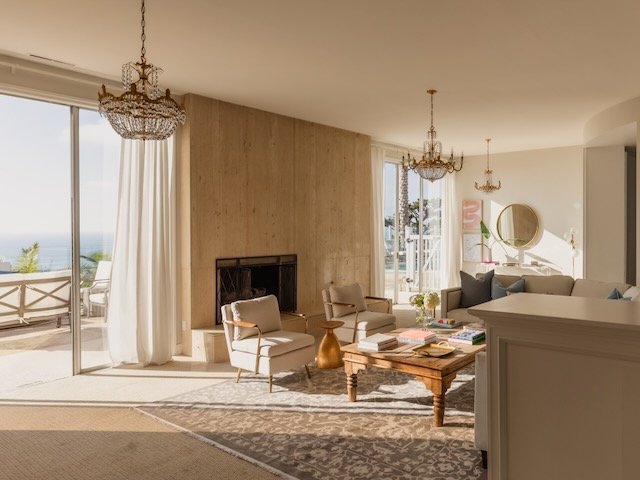
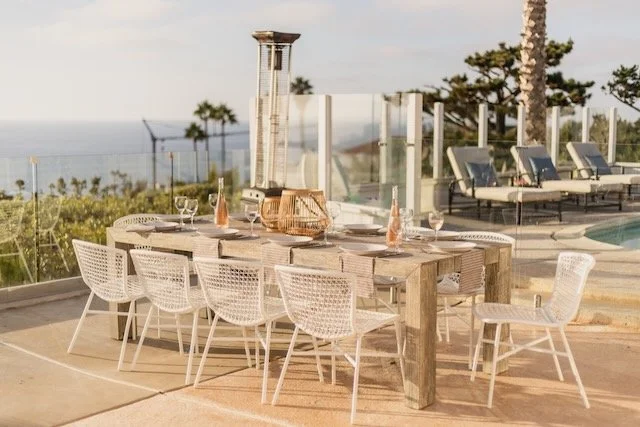
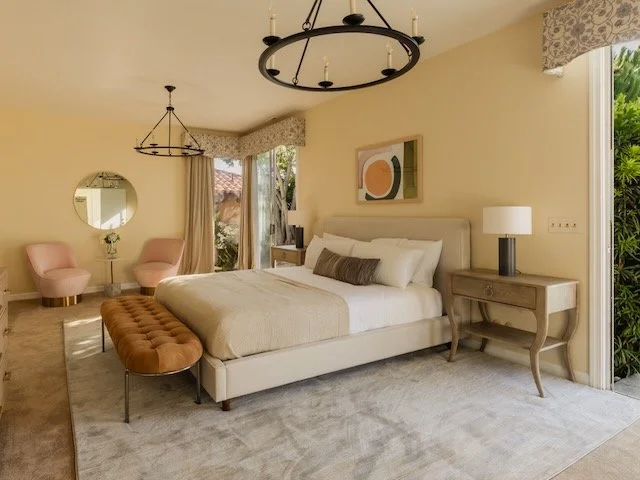
This property is a traditional coastal estate — warm palette interiors, chandelier-lit living spaces, classic architectural details — with a terrace that opens directly onto an ocean view and a dining terrace positioned so the Pacific sits behind every meal. The architecture is not the warm organic modernism that defines the current premium aesthetic in this market. What it delivers instead is something the contemporary listings often trade away in pursuit of minimalism: a sense that someone genuinely lives beautifully here, and that you can too.
San Diego guests are not always buying a design object. They are buying the feeling of how everyday life operates inside a house that faces the ocean. Morning coffee on the terrace. Dinner with the horizon behind the glasses. An afternoon in a bedroom that feels like it was decorated by someone with taste rather than a staging company. The existing photography had documented the rooms. It had not shown what living in them felt like.
The planning conversation surfaced a distinction that shapes every image decision in this market: Sonoma guests are buying a place. San Diego guests are buying a lifestyle. The three images in this sequence were chosen to show that lifestyle in the order a guest needs to see it — stop the scroll, build the trust, complete the story.
The guest isn't buying a house. They're buying how ordinary life feels inside that house when the ocean is on the other side of the glass.Planning session — San Diego
What San Diego Teaches Every Coastal Market
Coastal markets share a visual challenge that inland markets do not: the primary premium is invisible from most angles. You cannot see the ocean from inside a room unless the architecture allows it, and the photography shows it. These are the principles San Diego crystallized — applicable in any market where the primary premium is a view, an access point, or a relationship between the built environment and the natural one.
In any market where the premium is location-driven — coastal, mountain, vineyard, desert — the most common visual failure is photographing the interior without showing what it is located next to. A beautifully composed living room image is not evidence that the Pacific Ocean is on the other side of the glass wall. The image that shows both simultaneously is not harder to make. It requires standing in a different position and shooting at a different time of day. That image, in a coastal market, is worth more than every interior shot that preceded it in the gallery.
Every market has a recurring guest anxiety that experienced operators know exists and most listings fail to address directly. In San Diego it is the view credibility gap. In Sonoma it is the noise ordinance. In Joshua Tree it is the cellular dead zone. In Lake Tahoe it is the snow-access question in shoulder seasons. The listing that names the anxiety and resolves it — visually or in copy — converts through the trust verification stage without friction. The listing that leaves the anxiety unaddressed forces the guest to either send a pre-booking message or move on. At the premium tier, most of them move on.
In a saturated coastal market with multiple distinct micro-environments, positioning a property as belonging to the broader destination rather than its specific neighborhood is a measurable rate suppressor. La Jolla guests, Coronado guests, and Mission Beach guests are making different decisions based on different values. The listing positioned for all three appeals to none of them specifically. The precision required is not complex: it is the sub-market name, the actual drive time to the nearest anchor (the village, the boardwalk, the pier), and the specific landscape feature that defines the property's position within that sub-market. That specificity is the entire positioning argument.
If Your San Diego Listing Isn’t Converting, Start Here
The most common report from San Diego owners: “We’re getting views but people aren’t booking.” In almost every case, the answer is in one of five places — and most owners have not checked all five. Work through these questions against your current gallery. Where the answer is uncertain, the gap is real.
Does your gallery contain at least one image that shows the ocean and the interior of the home simultaneously? If guests are clicking but not booking, this is the most common single cause in this market. Not two separate images — one image, both registers in the same frame. When that proof image is missing, the primary promise of a San Diego coastal listing is invisible. No amount of copy compensates for it.
Is your STRO tier license number visible in your listing description? If guests are reaching your listing but abandoning before inquiring, regulatory anxiety is a likely friction point — and one most owners do not consider. Not in the house rules, not on request. In the structural description, where a guest running a compliance check will find it immediately. In a market with active enforcement, that number resolves a concern guests will not tell you they had.
Does your listing address the May Gray / June Gloom season directly? Owners who see a drop in March and April bookings for May–June arrivals are often facing this gap without knowing it. Guests who have experienced the marine layer before are looking for evidence that the property is livable when the sky is grey — a heated loggia, an indoor wellness space, ambient lighting that works. The San Diego short-term rental that acknowledges this earns trust. The one that ignores it manufactures an ambush for the guest who figures it out on arrival.
Is your outdoor privacy claim provable in the gallery? If the property has outdoor spaces that are shielded from boardwalk pedestrians, neighboring balconies, or public sightlines, is that demonstrated by an image taken from the outside looking in — or does the listing only show the outdoor furniture from within the space? The second approach leaves the privacy claim unverified. A guest who has been burned by an overstated privacy claim before will notice.
Is your sub-market positioning specific enough to filter for the right guest? "San Diego coastal property" describes several thousand listings. "La Jolla Shores — cliff-top above the Marine Reserve, fifteen minutes to the village" describes one. The second positions creates a much shorter competitive set and attracts guests who have already decided they want exactly that. Specificity is not limiting. It is qualifying. The wrong guest — the one who wanted a flat, walkable beach and chose La Jolla by mistake — leaves a review that costs you the right guest next season.
Curious How Your Listing Compares?
A Visual Performance Review applies this market intelligence directly to your property — identifying where your listing is losing trust — and exactly how to fix it.
Other Visual Performance Field Guides
Each market has its own guest psychology, visual language, and conversion logic. The framework travels; the application is always specific.