T
Visual Performance Field Guide — Lake Tahoe, California

What Lake Tahoe Demands Before a Guest Ever Clicks Book

Lake Tahoe is not one market. It is two entirely different guest economies sharing a shoreline. What works on the North Shore fails on the South. What converts in winter confuses in summer. Effective visual positioning here begins with understanding which guest you are actually speaking to — and building every decision around that answer.

Market Tier Tier 1 — Alpine / Lake Dual-Season
Design Paradigm Modern Alpine & Timber Tech
Regulatory Profile High — VHR Permit Caps Active
01 — Market Overview

Why Tahoe Is Not What Most Owners Think It Is

Guests choose Lake Tahoe over competing high-altitude destinations — Aspen, Vail, Park City — for a reason that rarely appears in listing copy: geography. Tahoe is the only North American market where world-class alpine skiing sits directly adjacent to one of the largest, deepest alpine lakes on the continent. That combination creates something neither a mountain resort nor a lake destination can replicate alone.

What that geography delivers, practically speaking, is scale, quiet, weather, water, and a sense of reset. For a certain guest — one with significant professional demands and very little unstructured time — that combination is not a nice-to-have. It is the entire reason they are willing to pay a premium nightly rate. They are not booking a vacation. They are buying back a week of clarity.

That dual-season structure also creates two completely different demand profiles occupying the same properties. The owner who understands this — and positions accordingly — operates a fundamentally different asset than the one who treats the property as a year-round mountain cabin.

The biggest visual mistake in this market is building a single hero image that works for neither season.
Visual Performance Observation — Lake Tahoe

The market divides geographically by a state line into two distinct premium behaviors. The North Shore / Truckee enclave delivers private, multi-acre forested compounds, elite golf-to-ski master-planned communities, and the kind of quiet that guests with high-demand professional lives specifically seek out. The South Shore / West Shore marina belt delivers lakefront access, private deep-water piers, and proximity to high-end entertainment and dining. This is not a stylistic distinction — it determines which guests your listing attracts and what visual proof they need before they commit.

$1,500+
Luxury baseline nightly rate for premium-tier properties
2
Distinct demand seasons requiring different visual positioning
High
Regulatory risk — permit caps limiting all new supply entry

The supply ceiling is real. Placer, El Dorado, and Washoe counties have all enacted VHR permit caps with multi-year waiting lists. Existing permitted properties are competing primarily against each other, not against new supply. In that environment, the listing quality, visual positioning, and the first impression each property makes become the primary variables that separate strong performers from average ones.

02 — Understanding the Premium Guest

Three Guests. Three Different Reasons to Book.

Most Lake Tahoe listings are photographed and positioned for a generic "luxury traveler." That positioning wins no one at this price point. The guests actually booking $1,500+ per night properties break into three distinct profiles — each with different visual triggers, different fears, and different proof they need before committing.

Persona 01
The Silicon Valley Tech Syndicate

Bay Area and Nevada tech founders booking the property as a working retreat or a deliberate break from high-demand schedules. They are not escaping to nature — they are using it. They travel with laptops, expect redundant internet infrastructure, and will pay significantly above market rate for absolute privacy from neighboring structures. Their home is already designed at a $5M+ standard. Your property needs to meet that bar or they will leave a measured, professional one-star review about the sheets.

Acoustic isolation Mesh Wi-Fi 300+ Mbps Smart home systems Private compound feel Integrated wellness
Persona 02
The Multi-Generational Legacy Family

High-net-worth families gathering adult siblings, aging parents, and children for annual ski weeks or summer lake traditions. The decision-maker is typically 45–58 years old with strong aesthetic standards and logistics responsibility for 12–18 people across three generations. They need bedroom parity for adult siblings, an industrial-grade kitchen, a dedicated children's space that keeps noise away from the primary suite, and evidence that the driveway will be cleared before elderly grandparents need to walk from the car. The emotional purchase is legacy — a property that becomes "our place."

Multi-master bedroom parity Commercial kitchen Children's bunk wing Elderly accessibility Snow management
Persona 03
The Elite Alpine Sports Enthusiast

Serious skiers or summer wakesurfers booking primarily for proximity to the experience — Palisades Tahoe, Northstar, or a private deep-water dock. They will spend 8–10 hours per day outside the property and treat the home as a high-performance recovery environment. Boot warmers, a heated mudroom with individual lockers, an outdoor hot tub with a mountain view, and a home that handles weather operationally are non-negotiable. Any ambiguity about ski proximity — and they are gone.

True ski-in/ski-out Heated mudroom + lockers Boot dry racks Private pier or dock Hot tub with mountain view

The visual implication is direct: a single listing gallery cannot serve all three profiles with equal effectiveness. The property that converts the Silicon Valley syndicate leads with great room volume and architectural seriousness. The multigenerational family needs to see the kitchen and the mudroom. The alpine sports enthusiast needs to see the thermal recovery loop. The sequencing of images — not just the images themselves — determines which guest self-selects in and which scrolls past.

03 — Where the Decision Is Made

The Tahoe Booking Journey Is Not Linear

Guests at this price point tend to conduct more pre-booking research than guests in most domestic markets. They return to listings across multiple sessions. They compare. They cross-reference with Instagram, design blogs, and word of mouth. Your listing has to survive not just a first impression, but a comparison session.

Understanding exactly where your visual assets are working — and where they are losing the guest — is the foundation of any meaningful optimization.

1
Search & Discovery
Map Thumbnail + Price

In Tahoe, guests filter to $1,000+ night before scanning thumbnails. Your hero image has to stop the scroll at this price tier — not just look good. A blurry hot tub photo loses to a sharp architectural exterior immediately.

2
First Impression — Critical Window
Hero Image + Rate + First Two Lines of Copy

This is where most continue-or-exit decisions are made. A hero image that communicates the wrong season, the wrong guest type, or fails to justify the rate invites immediate abandonment. A weak hero rarely survives the comparison stage that follows.

3
Gallery Scan
First 6 Images — Rapid Visual Qualification

Guests are scanning, not reading. Images 2–6 need to answer the three silent questions: Is this as large as it looks? Does it work for my group? Does it deliver on what the hero promised? Missing the mudroom, kitchen, or outdoor space here costs bookings.

4
Trust Verification — Second Critical Window
Reviews + Operational Claims + Host Profile

Tahoe guests tend to carry more operational anxieties at this stage than guests in most markets. Specific concerns: Is the ski or lake access claim accurate? Will snow be managed before arrival? Is there parking for three vehicles? What happens during wildfire smoke season? Listings that address these directly — visually in the gallery or explicitly in copy — tend to move through this stage with less hesitation than those that leave the answers to inference.

5
Price Comparison
Return Visit + Competitor Shortlist

At this price tier, most guests shortlist 2–3 properties before booking. The listing that wins this stage is usually not the cheapest — it is the one with the clearest specific claim. "Private compound, 200 acres, no neighboring structures visible" beats a longer amenity list.

6
Commitment
Final Review + Book

Guests who reach this stage have self-qualified. The only thing that stops a booking here is an unresolved anxiety from Stage 4. If the trust verification stage was handled well visually, this stage converts cleanly.

04 — Competitive Landscape

What High-Performing Listings Do Differently

Traditional Tahoe design — heavy timber, knotty pine, stone fireplaces, warm wood tones — can read as timeless and grounded when it is well-lit, well-sequenced, and presented with intention. The same elements, when poorly photographed or visually overemphasized, register as dated and heavy against the cleaner aesthetic guests increasingly associate with the price point they are considering. The issue is rarely the design itself. It is how the design is framed and which details are foregrounded.

The design language gaining traction in high-performing listings is Mountain Modernism — exposed steel, soaring ceilings, architectural glass, clean-lined vertical cedar, and light-toned interiors. Properties with this aesthetic tend to photograph well against both winter and summer contexts. Understanding where the market's visual reference points have shifted is useful context for any positioning strategy, regardless of a property's design era.

Category What It Looks Like Signal
Baseline Expectation
Guests assume this without seeing it
Fast mesh Wi-Fi, automated check-in, premium mattress systems, multi-zone climate control, EV charging Table Stakes
Commoditization Trap
Owners invest here thinking it differentiates
Standard hot tub on bare concrete, pool table in the garage, stock stone fireplace, generic mountain decor No Lift
Meaningful Differentiation
Top-performing listings provide this; others cannot easily replicate it
Hydronic radiant heated driveways, custom spa grottos, private indoor pools, ski-in/ski-out trail permissions, deeded deep-water docks Premium Signal
Visual Differentiation
What top listings photograph that others miss entirely
Heated mudroom with custom gear storage, the thermal recovery loop (sauna → cold plunge → hot tub), the great room window wall with lake or mountain behind it, the moment of winter warmth against alpine exterior Conversion Asset

The Three Listing Types You're Competing Against

At the $1,500+ per night tier, the competitive field breaks into three recognizable listing profiles. Each has a predictable visual posture — and a predictable gap that a more strategically positioned property can exploit.

Corporate-Managed Portfolio Listings
Properties managed by Vacasa, Evolve, Tahoe Luxury Properties
How They Compete

High marketing reach and platform visibility. Consistent pricing strategies and review volume. Guests trust the brand more than the individual property — which means the listing itself rarely has to work hard. Visuals are adequate and interchangeable across the portfolio.

Where the Gap Is

No guest-avatar specificity. The hero serves no guest in particular. Operational proof shots — mudroom, gear storage, thermal recovery — are rarely included. At scroll speed, these listings look like every other listing at their price point. A well-positioned independent listing can consistently out-convert on first impression.

Design-Forward Independent Properties
Self-managed, high-investment interiors, strong online presence
How They Compete

Genuine design investment. Often beautifully photographed with strong hero images. Active on Instagram. The property itself is premium and the visual presentation reflects that. Guests in the research phase will encounter these listings and take them seriously.

Where the Gap Is

Visual strategy is aesthetic rather than psychological. Beautiful images, but in the wrong sequence for the guest they're trying to attract. No seasonal variation in hero positioning. The listing shows what the property looks like — but doesn't answer the specific questions that move a guest from consideration to commitment at this price point.

Established Legacy Properties
Long-standing Tahoe listings with high review volume and repeat guests
How They Compete

Booking momentum built over years. High review counts that create platform ranking advantages. Return guests who book before the listing ever appears in a search result. These properties often hold rates and occupancy without visible marketing effort.

Where the Gap Is

Visual positioning is rarely updated. A property with five years of strong reviews and 2018-era photography is vulnerable to a newer listing with a sharper visual argument — particularly for first-time guests entering the market. The legacy review advantage does not protect against a weaker first impression in the search results.

The consistent opening across all three competitor profiles is guest-avatar precision. Few listings at any tier make deliberate decisions about which specific guest they are positioning for before their visual strategy is built. That specificity — knowing who the listing is for before any other decision is made — is where meaningful differentiation lives.

Tahoe-Specific Trust Signals Most Listings Leave Invisible

Beyond aesthetics, guests in this market carry a specific set of operational concerns. These are not obscure edge cases — they surface consistently across the booking journey and influence decisions at the comparison stage. Listings that address them directly, either visually or in copy, tend to convert more cleanly at higher rates.

Guest Concern What Converts
Ski & lake access
Proximity claims are frequently exaggerated
A photo of the trailhead, dock, or access point from the property itself. Copy that states minutes, not “near” or “close to.”
Snow management
Multi-gen families and groups with elderly guests need specifics
A driveway or entry shot after a storm. Clear copy on who clears the property and on what schedule.
Wildfire smoke
Late summer bookings carry active air quality anxiety
A photo or mention of whole-home air filtration. Even a single visible HEPA unit in a common area builds measurable trust.
Neighbor proximity
Privacy claims are almost always underdocumented
An exterior or aerial shot that shows actual setback and tree buffer. The claim “private” needs visual evidence at this price point.
Parking & EV charging
Groups arriving in multiple vehicles expect this to be solved
A parking area or garage shot, especially if EV charging is available. Rarely shown; frequently asked about in pre-booking messages.
Bear & trash protocols
First-time Tahoe guests are often unfamiliar with local requirements
Explicit copy on bear-box location and trash procedures. Guests who are surprised by this mid-stay tend to leave lower operational reviews.
Power resilience
Remote properties and storm-season guests ask about this
If the property has a generator or battery backup, this belongs in the listing. It answers an anxiety most guests won't voice before booking.
B
05 — Applying the Visual Performance Framework

Ben & Traci — Lake Tahoe, California

Ben and Traci came to the project with a property that had everything this market asks for: heavy timber beams, a soaring great room, full-height windows with a direct visual connection to the lake, and interior design that was already at the level their guests expected. On paper, this should have been a straightforward assignment.

During the planning conversation, one thing became clear immediately. Dozens of comparably appointed properties were competing for the same weekend booking. Beautiful photography would not be enough. The question was never "how do we make this look good?" — it was "which guest are we actually photographing this for, and what do they need to see before they believe the nightly rate?" Every shot decision followed from the answer to that question.

We spent more time deciding which images to leave out than which ones to shoot.
Planning session — Ben & Traci, Lake Tahoe
The Promise
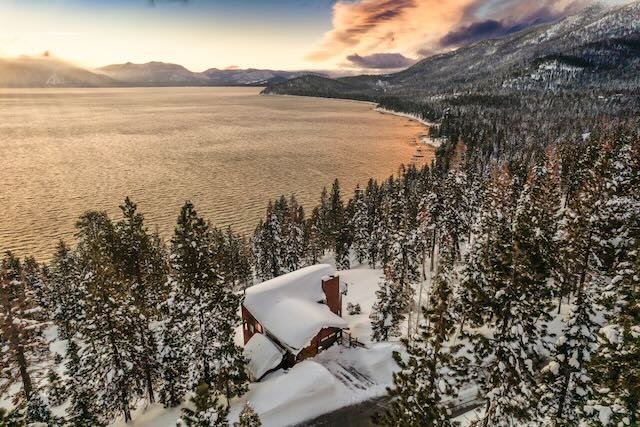
Aerial winter drone view of Ben and Traci's Lake Tahoe property showing lake proximity and snow-covered pine forest at golden hour
Aerial establishing shot — proves location, lake proximity, and privacy in a single frame before the guest reads a single word
The Experience
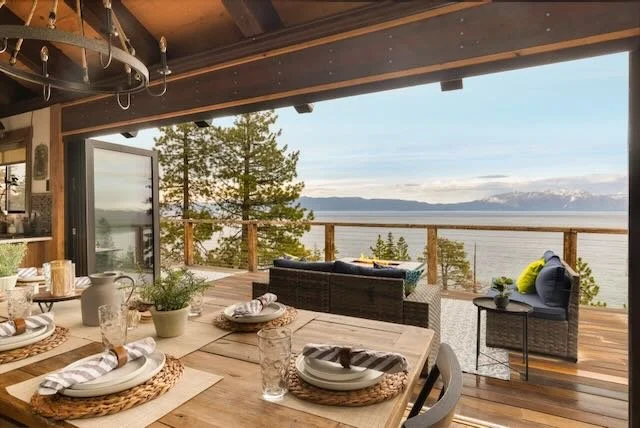
Covered outdoor dining deck with set table, fire pit seating, and panoramic Lake Tahoe view at dusk
The property delivering on the promise — indoor-outdoor dining with the lake as permanent backdrop, in season and at its best
The Execution
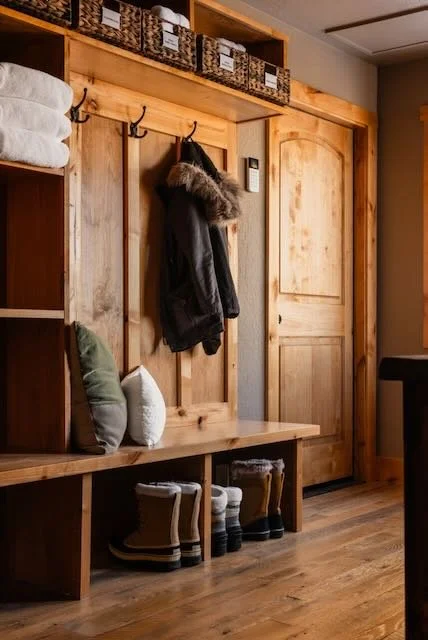
Custom built-in mudroom with ski jacket, snow boots, organized bench seating and labeled storage baskets
Operational detail that justifies the rate — a mudroom designed for alpine guests communicates that this property was planned, not just furnished
01
Guest Psychology
The aerial establishes location credibility before the guest has read a single word of copy. Guests paying $1,500+ per night carry a specific anxiety: they want to verify the lake proximity claim is real, not a wide-angle trick from a ground-level angle. A drone shot at golden hour, with the property roof visible and the water filling the horizon, resolves that anxiety in under two seconds. The emotional need being addressed is confirmation, not wonder.
02
Market Alignment
Lake Tahoe commands a premium precisely because the lake and the surrounding forest are the product — not the house. The outdoor dining deck image aligns with that market reality by making the lake the visual subject and the property the supporting element. The table in the foreground, the fire pit beyond it, and the water and mountains behind both confirm that every gathering space here is organized around the same asset: the view. That is the correct hierarchy for this market.
03
Visual Hierarchy
The mudroom image is the third image for a reason. By the time a guest reaches it, they have already accepted the location and the experience. Now they are looking for friction — reasons to doubt whether the property delivers at the operational level. The mudroom answers those doubts in sequence: the bench says there is space to gear up and down, the hooks say coats and jackets were anticipated, the labeled baskets say someone manages this property with intention. The hierarchy is: promise → experience → proof.
04
Trust Signal
A custom built-in mudroom with ski boots on the bench and a winter jacket on the hook is a trust signal aimed specifically at alpine guests. It proves the property was designed for how they actually use it — not retrofitted for the category. Most Tahoe listings that compete on rate describe their ski access in bullet points. This image makes the same claim without using a single word, and makes it more credibly: the infrastructure already exists, and a guest captured it in use.
05
Strategic Lesson
These three images were selected to answer three questions in sequence — questions every premium Tahoe guest is asking before they book. Is the location actually what it claims to be? (aerial) What does it feel like to be here? (deck at dusk) Will the details hold up? (mudroom). A visual strategy is not a collection of beautiful images. It is a sequence of answers. The order matters as much as the images themselves.
$2,100
Nightly rate at listing launch
Ongoing
Expanded to multi-property portfolio engagement
VPR
Full Visual Performance Review — strategy-first, directed capture
06 — Universal Principles

What Lake Tahoe Teaches Every Premium Market

Every market refines the Visual Performance Framework with observations that travel beyond their geography. These are the principles Lake Tahoe reinforced — applicable across any dual-season, high-regulation, or high-anxiety premium market.

Principle 01
Dual-Season Properties Require Dual-Season Visual Positioning

Any market with strong summer and winter demand requires a hero image that serves both seasons or rotates by season. A single hero optimized for one season is actively converting the wrong guest for half the year. This is a strategy decision made before the shoot begins, not an editing decision made after.

Applicable to
Lake Tahoe
Mammoth Lakes
Jackson Hole
Park City
Principle 02
Operational Proof Converts High-Anxiety Guests

In markets with environmental stressors — weather, wildlife, wildfire, remoteness — guests carry specific operational anxieties. The listing that visually addresses those anxieties builds trust that purely aesthetic photography cannot. The mudroom, the snow management system, the air filtration — these are conversion assets, not supplementary shots.

Applicable to
Lake Tahoe
Joshua Tree
Sedona
Any remote market
Principle 03
Micro-Market Precision Outperforms Generic Regional Positioning

Lake Tahoe's North Shore and South Shore attract different guests with different purchasing triggers. The property that positions itself precisely — as a Truckee compound, a West Shore lakefront estate, an Incline Village Nevada sanctuary — outperforms the one positioned as "luxury Lake Tahoe cabin." Specificity is not limiting. It is qualifying. The right guest self-selects in; the wrong guest self-selects out before they can leave a misaligned review.

Applicable to
Lake Tahoe
Sonoma
Malibu
All multi-zone markets
07 — Evaluate Your Own Listing

Five Questions a Tahoe Owner Should Be Able to Answer

Before investing in new photography or listing optimization, use these to locate exactly where your current visual positioning is losing qualified guests. They come directly from the 5-Dimension Score applied to this market.

01

Does your hero image communicate premium value in both winter and summer, or have you optimized for one season and inadvertently filtered out the other? Pull your listing up in June and ask whether it reads as compelling to a summer guest. That is the test.

02

Does your gallery include a single image of the mudroom, gear room, or thermal recovery loop? If not, you are photographing the aesthetics of the property while leaving its operational excellence — the thing that justifies the rate at this price point — invisible.

03

Does your listing specifically address wildfire smoke anxiety? If you have a whole-home air filtration system and your listing does not show it, you are losing late summer bookings to properties that do. This is one of the highest-impact, lowest-effort trust signals in the market.

04

Is your ski-in/ski-out or lake access claim visually verified? Guests have been burned by ambiguous proximity claims before. A photo of the ski trail directly accessible from the property — or the private dock from the deck — is worth more than any descriptor in the listing title.

05

Which of the three guest profiles is your listing actually built for? If the answer is "all of them," the answer is probably none of them. Guests self-select when the listing feels like it was designed for someone exactly like them.

Next Step

Curious How Your Listing Compares?

A Visual Performance Review applies this market intelligence directly to your property — identifying where your listing is losing trust — and exactly how to fix it.

Continue Reading

Other Visual Performance Field Guides

Each market has its own guest psychology, visual language, and conversion logic. The framework travels; the application is always specific.