J
Visual Performance Field Guide — Joshua Tree, California

What Joshua Tree Demands Before a Guest Ever Clicks Book

Joshua Tree is the only premium STR market where the value proposition is built entirely on the absence of things. No resort infrastructure, no urban conveniences, no proximity signals. The guest is paying for silence, dark skies, and geological scale. Every visual decision must answer one question first: does this image prove that nothing is in the way?

Market Tier Tier 2 — Desert Drive-To
Design Paradigm Desert Minimalism & Architectural Radicalism
Regulatory Profile Moderate — San Bernardino County STR Ordinance Active
01 — Market Overview

Why Joshua Tree Is Not What Most Owners Think It Is

Guests choose Joshua Tree over competing regional drive-to destinations — Palm Springs, Big Bear, Ojai — for a reason that rarely appears in listing copy: the inversion of value. In most luxury markets, proximity to amenities drives the premium. Here, distance from them does. The further a property sits from neighbors, highways, and light pollution, the higher its ADR ceiling — provided the architecture can justify the rate on its own terms.

What that environmental isolation delivers, practically speaking, is acoustic silence, unobstructed dark skies certified by the International Dark-Sky Association through Joshua Tree National Park, and expansive horizons measured in miles rather than feet. For a specific guest — one arriving from a high-stimulus metropolitan environment with very little unstructured time — these are not amenities. They are the entire reason for booking. They are paying for a measurable drop in nervous system arousal. The property is the vehicle; the desert is the product.

That distinction carries a direct visual implication. Every image in the listing gallery must either prove the isolation or prove the architecture. Images that do neither — the standard interior detail shot, the posed aerial that happens to include a nearby subdivision — actively undermine the positioning. In this market, what is not in the frame is as important as what is.

The biggest visual mistake in Joshua Tree is hiding the context to show the house. The context is what you are selling.
Visual Performance Observation — Joshua Tree

The market divides into a meaningful geographic hierarchy that is poorly understood by operators who entered from outside the region. South Joshua Tree — the boulder-integrated pockets near the national park boundary, Monument Manor, and the elevated terrain around Upper Moonridge — operates in a fundamentally different financial and experiential tier. Properties here are built into ancient monzogranite formations, with the geology as a design partner rather than a backdrop. North Joshua Tree and Yucca Valley offer more accessible price points and higher permit availability, but the visual challenge intensifies: flat, sandy five-acre grids with neighboring structures in view require a more deliberate framing strategy to command premium rates.

$600+
ADR threshold for premium-tier properties with architectural distinction
3
Distinct geographic sub-markets with significantly different revenue ceilings
Active
San Bernardino County STR ordinance — noise, light, and occupancy enforcement ongoing

Supply in the premium tier is constrained not by permit caps — as in Tahoe — but by geology. There are a finite number of boulder-integrated lots, elevated parcels with unobstructed horizon lines, and properties with documented architectural provenance. Operators in those locations are competing primarily against each other, not against new supply. In that environment, visual positioning becomes the primary variable separating high performers from average ones.

02 — Understanding the Premium Guest

Three Guests. Three Different Versions of the Desert.

Most Joshua Tree listings are positioned for a generic "design-forward traveler." That positioning serves no one at the premium price point. The guests actually booking $600+ per night properties in this market break into three distinct profiles — each with different visual triggers, different fears, and different proof they need before committing.

Persona 01
The Metropolitan Creative Decompressor

Arriving primarily from Los Angeles, San Francisco, and New York, this guest is using the desert as a therapeutic reset from a high-stimulus professional environment. They are not on vacation — they are on a deliberate circuit break. They have strong aesthetic standards because their daily environment already operates at a high design level, and they will notice immediately when a property does not match the visual promise of its listing. Their fears are specific: neighbors whose vehicles are visible from the soaking tub, highway noise bleeding into the silence they paid for, and visual intrusions — power lines, chain-link fences, a neighboring property's exterior floodlight — that fracture the isolation claim.

Architectural provenance Complete horizon privacy High-fidelity sound Designer interiors Starlink confirmed
Persona 02
The Dark-Sky & Wellness Purist

This guest aligns their booking with celestial events — new moons, meteor showers, specific planetary alignments — and treats the property as a functional wellness environment. They research elevation, dark-sky certification, and outdoor infrastructure before looking at interior photography. Their needs are technical: complete light-pollution absence, purpose-built stargazing setup, and integrated thermal wellness programming (sauna, cold plunge, outdoor shower). Their concerns are also technical: poor outdoor lighting design that ruins night vision, wildlife management protocols that have not been thought through, and sound compliance rules that prevent them from running acoustic instruments outdoors in the evening.

IDA dark-sky area Sauna + cold plunge Zero light pollution Stargazing platform Wildlife protocols
Persona 03
The High-Design Social Gatherer

Milestone celebrations, intimate group retreats, and creative residencies. This guest is booking a multi-structure compound or a large-format property for 8–16 people, and they are evaluating the property primarily through the lens of communal living quality. The outdoor flow matters as much as the interior. They want a kitchen that can handle a sit-down dinner for 14, equal-caliber bedrooms that avoid the "bad room" conflict in a group, and distinct outdoor focal points — an integrated boulder pool, a fire pavilion, a concrete dining platform — that give the gathering purpose. Their fears are operational: inadequate hot water capacity, noise compliance that shuts down a low-key outdoor dinner, and poor indoor-outdoor flow that forces the group to choose between inside and outside rather than moving fluidly between both.

Multi-structure compound Bedroom parity Integrated outdoor dining In-ground pool or tub High-capacity kitchen

The visual implication is direct: a single listing gallery cannot serve all three profiles with equal effectiveness. The metropolitan creative needs to see the horizon and the architecture. The wellness purist needs to see the thermal circuit and the absence of light pollution. The social gatherer needs to see the communal outdoor space and the kitchen. The sequencing of images — not just the images themselves — determines which guest self-selects in and which scrolls past without booking.

03 — Where the Decision Is Made

The Joshua Tree Booking Journey Has an Unusually Long Research Phase

Guests at this price point tend to conduct more pre-booking research than guests in most domestic drive-to markets. The remoteness of the location — and the specific operational anxieties that come with it — extend the consideration window. Guests return to listings multiple times, cross-reference with design publications, and read reviews with forensic attention to detail. A listing that survives only a first impression is not competing effectively here.

Understanding exactly where your visual assets are working — and where they are losing the guest — is the starting point for any meaningful optimization.

1
Search & Discovery
Map Thumbnail + Price Filter

In Joshua Tree, guests filter by location and price before scanning thumbnails. At the $600+ tier, the thumbnail image has to immediately communicate architectural distinction — not standard vacation rental interiors. A dark concrete wall against a boulder formation stops the scroll. A staged living room with macramé does not.

2
First Impression — Critical Window
Hero Image + Rate + Opening Copy

This is where most continue-or-exit decisions are made. A hero image that fails to communicate isolation — one that inadvertently shows a neighboring roofline, a dirt road with visible tire tracks leading to another structure, or an interior shot that could be anywhere in the country — loses the booking immediately. The hero must prove the desert before anything else is read.

3
Gallery Scan
First 6 Images — Rapid Visual Qualification

Guests are scanning, not reading. Images 2–6 need to answer three silent questions: Is the isolation real or a wide-angle trick? Does the architecture match the price point? Does the outdoor space actually work — in the summer heat, and at night? The listing that answers all three in the first six frames advances to the research phase. The one that answers only one does not.

4
Trust Verification — Second Critical Window
Reviews + Road Access + Operational Claims

Joshua Tree guests carry a specific set of operational anxieties at this stage that are more acute than in most markets. Primary concerns: What is the access road condition and vehicle clearance required? How does the HVAC system handle 110°F summer afternoons? Is the claimed isolation actually verifiable, or is a neighbor's structure visible from the outdoor soaking tub? Are the wildlife protocols clearly documented? Listings that address these directly — visually in the gallery or explicitly in copy — tend to move through this stage with significantly less hesitation than those that leave the answers to inference.

5
Price Comparison
Return Visit + Competitor Shortlist

At the $600+ tier, most guests shortlist two or three properties before booking. The listing that wins this stage is rarely the cheapest — it is the one with the most specific, verifiable claim. "Boulder-integrated architecture on a private seven-acre parcel, no neighboring structures within visual range" outperforms a longer amenity list. Specificity reads as credibility.

6
Commitment
Final Review + Book

Guests who reach this stage have self-qualified. The only thing that stops a booking here is an unresolved anxiety from Stage 4 — typically the road access concern or a privacy claim that was never visually verified. If the trust verification stage was handled well, this stage converts cleanly.

04 — Competitive Landscape

What High-Performing Listings Do Differently

The boho-chic aesthetic that dominated Joshua Tree listings from 2015 to 2020 — macramé, pampas grass, wicker, butterfly chairs, oversaturated turquoise and terracotta color palettes — was not inherently wrong for the market it served. The problem is that it now reads as a specific price tier signal rather than a premium one. When the same design language appears at a $150-per-night glamping tent and a $1,000-per-night compound, the compound loses the visual argument before the guest reads the rate. The aesthetic is not the issue. The misalignment between aesthetic and price point is.

The visual language gaining ground in high-performing premium listings is desert architectural purity — rammed earth, raw concrete, Corten steel, plaster walls, polished stone, and monochromatic palettes drawn from the surrounding landscape. These properties photograph differently because they are oriented differently: the architecture frames the desert rather than competing with it, and the images that result communicate a design philosophy rather than a decoration style.

Category What It Looks Like Signal
Baseline Expectation
Guests assume this without seeing it
Starlink internet, automated check-in, central A/C with strong BTU capacity, outdoor seating with shade structure, EV charging Table Stakes
Commoditization Trap
Owners invest here thinking it differentiates
Standard plug-in hot tub, string lights across open desert, boho-chic interior decor, stock rock fire pit, off-the-shelf cowboy pool No Lift
Meaningful Differentiation
High-performing listings provide this; others cannot easily replicate it
Architecture built into or directly adjacent to boulder formations, in-ground concrete or stock-tank pools, integrated cedar sauna and cold plunge, documented architectural design credit, private land buffer with no neighboring structures in sightlines Premium Signal
Visual Differentiation
What top listings photograph that others miss entirely
The property at midnight with the Milky Way visible and no competing light sources; the arrival approach showing the structure emerging from the desert; the indoor-outdoor transition at civil twilight; a close detail of the boulder formation as architecture Conversion Asset

The Three Listing Types You're Competing Against

At the $600+ per night tier in Joshua Tree, the competitive field breaks into three recognizable listing profiles. Each has a predictable visual posture — and a predictable gap that a more strategically positioned property can exploit.

Corporate-Managed Portfolio Listings
Properties managed by Evolve, Vacasa, and regional desert STR management companies
How They Compete

Strong platform reach and review volume. Consistent operational protocols and pricing optimization. Guests who are unfamiliar with the market often book these listings because the brand provides a level of perceived safety. Visuals meet a minimum standard and are regularly updated on a fixed schedule.

Where the Gap Is

No guest-avatar specificity. The photography is adequate but interchangeable — the same visual approach used across a portfolio of a hundred properties in multiple markets. Trust signal photography — road access, privacy verification, wildlife management, thermal infrastructure — is rarely included. A strategically positioned independent listing can consistently out-convert on first impression with guests who know exactly what they are looking for.

Design-Forward Independent Properties
Self-managed, high architectural investment, active Instagram and design publication presence
How They Compete

Genuine architectural investment and strong visual presence. These listings tend to be discovered through design publications, Instagram, and word-of-mouth within creative professional networks. The properties are often genuinely premium and their photography reflects that. A guest in the research phase will encounter them and take them seriously.

Where the Gap Is

Visual strategy is aesthetic rather than psychological. Beautiful images, but sequenced for visual appeal rather than guest conversion. Trust signal photography is missing: the access road, the privacy perimeter, the operational infrastructure that justifies staying in a remote desert location. The listing shows what the property looks like at its best — but doesn't answer the specific anxieties that move a guest from consideration to commitment.

Established Legacy Properties
Long-standing desert listings with high review volume and strong repeat booking rates
How They Compete

Booking momentum built over years. High review counts that generate platform ranking advantages. Some degree of repeat guest traffic that fills calendars before the property ever appears in a search result. These properties often hold rate and occupancy without active visual marketing effort.

Where the Gap Is

Visual positioning is rarely updated to reflect the market's shifted aesthetic standard. A property with five years of strong reviews and 2019-era boho-chic photography is increasingly vulnerable to a newer listing with sharper architectural framing — particularly for first-time Joshua Tree guests entering the market with a higher design expectation. The legacy review advantage does not protect against a weaker first impression in search results.

The consistent opening across all three competitor profiles is trust signal invisibility. Few listings at any tier make deliberate decisions to visually address the specific operational anxieties that Joshua Tree guests carry. Addressing those anxieties — with actual images, not copy alone — is where meaningful differentiation lives in this market.

Joshua Tree-Specific Trust Signals Most Listings Leave Invisible

Beyond aesthetics, guests in this market carry a set of operational concerns specific to the desert environment. These surface consistently across the booking journey and influence decisions at the comparison stage. Listings that address them directly tend to convert more cleanly at higher rates than those that leave the answers to inference.

Guest Concern What Converts
Road access and vehicle clearance
Guests frequently arrive in low-clearance vehicles; sand and rock conditions vary seasonally
A photo of the access road from the property boundary in dry conditions. Explicit copy stating vehicle clearance minimum and road conditions after rain. Never leave this to inference.
Isolation claim verification
Privacy claims are almost always underdocumented and frequently exaggerated
An aerial or wide exterior shot that shows actual parcel boundaries, neighboring structure distances, and sightline clearance from the primary outdoor amenity. The word "private" requires visual evidence at this price point.
Summer heat management
Temperatures exceeding 110°F create real anxiety about outdoor livability
A photo of shade structures, exterior misters, or a pool with visible water temperature equipment. Copy that states HVAC capacity in BTUs or tonnage. Guests need to know the property was engineered for the climate, not just located in it.
Wildlife — rattlesnakes, scorpions
First-time desert visitors carry significant anxiety about encounters
Explicit copy on management protocols and seasonal patterns. A photo of perimeter screening if it exists. Guests who are surprised by this mid-stay tend to write reviews that damage the property's positioning regardless of how well everything else went.
Cellular and internet connectivity
Starlink availability is increasingly expected; cellular dead zones are a known concern
Confirm Starlink by name in the listing copy. A photo of the dish on the roof signals that the infrastructure is there and was anticipated. Guests who lose connectivity mid-stay in a remote location have a qualitatively worse experience than guests who expected and accepted limited cell service.
Neighbor visibility from outdoor amenities
Guests have been burned by ambiguous isolation claims before
A photo taken from the outdoor soaking tub or pool showing the actual sightline. If no neighboring structures are visible, that image is worth more than any descriptor in the listing title.
Off-grid and power resilience
Desert properties with solar or battery backup are increasingly viewed as a premium signal
If the property operates on a solar microgrid or has battery backup, this belongs in the listing. It answers an anxiety most guests will not voice — and positions the infrastructure as a luxury feature rather than a rural compromise.
D
05 — Applying the Visual Performance Framework

Erin — Joshua Tree, California

Erin's property sits on elevated desert terrain in South Joshua Tree, positioned so that the mountain range to the north becomes the primary visual context for every room in the house. The architecture is low-profile and horizontal — the kind of building that doesn't compete with its surroundings, but frames them. The existing photography, shot at midday, had documented the property accurately. It had not communicated what it actually felt like to be there.

During the planning conversation, one distinction kept surfacing: guests booking at this price point are not evaluating square footage or amenity lists. They are evaluating whether the experience the listing describes is real. That changes which images matter. It changes when you shoot. And it changes which images you leave out, which is often the harder decision.

The question we kept coming back to was not “does this look good?” It was “does this prove something a guest needs to believe before they book?”
Planning session — Joshua Tree
Stop the Scroll
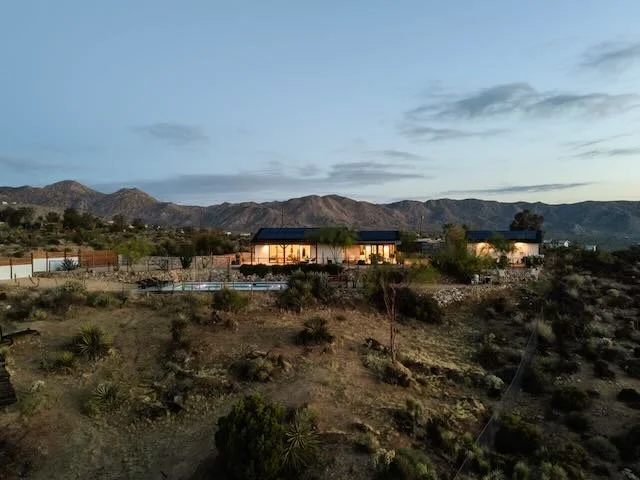
Aerial dusk view of Erin's Joshua Tree property — low-profile modern home glowing against desert terrain with mountain range behind
The home belongs to the landscape — aerial at civil twilight establishes context, scale, and setting before the guest reads a single word
Build Trust
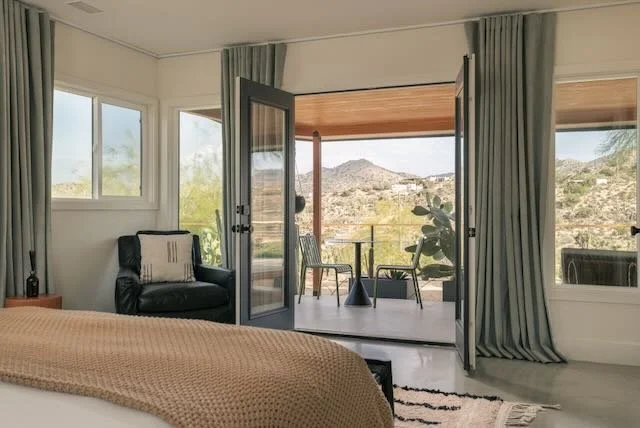
Primary bedroom interior with French doors open to desert mountain view — black leather chair, warm bedding, desert plants beyond
The bedroom opens directly to the landscape — what guests are buying is immediate access to quiet, light, and space
Complete the Story
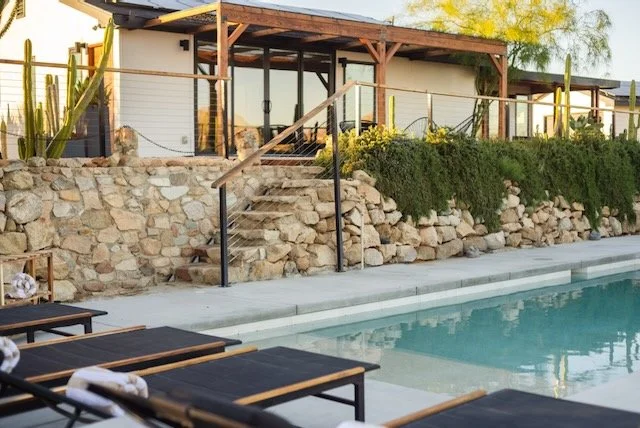
Aerial view of lap pool integrated into desert planting — agave, desert willows, and loungers visible against warm golden terrain
The pool isn’t presented as an amenity — its placement within the desert planting demonstrates privacy, intention, and a landscape that supports relaxation rather than competing with it
01
Guest Psychology
This image was made at five in the morning. That detail matters. The quality of light in the frame — the pre-dawn sky, the property illuminated against still-dark terrain, the mountain range just becoming legible — is not something that can be approximated at a more convenient hour. It resolves the most important anxiety a Joshua Tree guest carries: is the isolation real, or is it a wide-angle illusion? A drone image that shows the property against open desert with no neighboring structure visible answers that question before the guest reads a word of copy. The emotional need being met is confirmation. Getting the shot sometimes means being on location before the desert wakes up.
02
Market Alignment
In Joshua Tree, what guests are purchasing is access — access to silence, light, and a quality of space that is only available at this remove from the city. The bedroom image aligns with that market reality precisely because it does not show a bedroom. It shows a threshold: a set of doors open to the desert, a mountain range filling the frame beyond, and a room designed so that the landscape is always present. That is the correct visual argument for this market. The architecture is the frame. The desert is the subject.
03
Visual Hierarchy
This sequence tells Context → Feeling → Proof, which is a fundamentally different structure than the standard House → Amenity → Amenity pattern. By the time a guest reaches the pool image, they have already accepted the location and felt what being there is like. The pool is not being introduced as a feature — it is being confirmed as an extension of the same logic the first two images established. Placed third, it reads as evidence. Placed second, it would read as a selling point. The difference is how much trust the guest has already built before they see it.
04
Trust Signal
The pool aerial addresses a specific trust doubt that surfaces in premium Joshua Tree listings: the question of whether the outdoor amenity is placed with intention or simply installed on an available patch of concrete. A pool photographed at eye level against a plain fence is an amenity. The same pool shot from above, surrounded by mature desert planting, with agave and native species framing the sightlines, signals a design decision. It tells the guest that someone thought carefully about how this property exists in its environment — which is, functionally, what they are paying for.
05
Strategic Lesson
These three images were not selected because they look good — they were selected because each one proves something. The aerial proves the location claim. The bedroom proves the experience claim. The pool proves the design claim. A visual strategy is a sequence of answers to the questions a guest is asking in the order they are asking them. The prior photography showed what the property looked like. This sequence shows what it would feel like to have booked it correctly. That is the shift: from documentation to confidence.
$950
Nightly rate at listing launch following visual repositioning
VPR
Full Visual Performance Review — strategy-first, directed capture
Ongoing
Continued engagement for seasonal gallery updates
06 — Universal Principles

What Joshua Tree Teaches Every Premium Market

Every market refines the Visual Performance Framework with observations that travel beyond their geography. These are the principles Joshua Tree reinforced — applicable across any remote, high-anxiety, or isolation-premium market where the environment itself is the core product.

Principle 01
What Is Not in the Frame Is Part of the Visual Argument

In any market where the value proposition is built on isolation, absence, or exclusivity, the negative space in an image carries as much meaning as the subject. An outdoor living area photographed so that no neighboring structure, no highway, and no artificial light source appears in the frame is making an active claim about the property's positioning. That claim is more credible than any copy because it cannot be easily fabricated. Visual strategy in isolation markets is as much about what you choose to exclude as what you choose to include.

Applicable to
Joshua Tree
Sedona
Big Sur
Any remote market
Principle 02
The Light Transition Is the Product — Not a Styling Opportunity

In markets where the natural environment has a dramatic daily arc — desert golden hour, alpine twilight, coastal fog burn-off — the most commercially effective images are those taken at the moment of transition rather than at midday. This is not a stylistic preference. It is an alignment between what the guest is actually purchasing and what the image communicates. A property photographed only at noon is being documented. A property photographed across its full daily arc is being sold.

Applicable to
Joshua Tree
Lake Tahoe
Malibu
All light-sensitive markets
Principle 03
Geographic Sub-Market Position Outperforms Generic Regional Branding

Joshua Tree is not a homogenous market. A property in the boulder-integrated terrain of South Joshua Tree and a property on a flat five-acre grid in North Joshua Tree are not competing in the same segment, regardless of how they are priced. The property that positions itself precisely — by elevation, by geological context, by proximity to protected land — attracts guests who are specifically looking for that context. The property positioned as a generic "Joshua Tree desert retreat" is competing on price with every other generic listing. Precision in positioning is not limiting. It is qualifying.

Applicable to
Joshua Tree
Lake Tahoe
Sonoma
All multi-zone markets
07 — Evaluate Your Own Listing

Five Questions a Joshua Tree Owner Should Be Able to Answer

Before investing in new photography or listing optimization, use these to locate exactly where your current visual positioning is losing qualified guests. They come directly from the 5-Dimension Score applied to this market.

01

Does your hero image prove isolation, or does it just show the property? Pull your listing up and ask whether a guest can verify, from that single image, that no neighboring structure is visible from the outdoor living area. If the answer is no — if the hero is an interior shot, a standard exterior against a blue sky, or an aerial that happens to include a subdivision in the background — your most important conversion asset is not doing its job.

02

Does your gallery include at least one image taken during the light transition — golden hour, civil twilight, or full dark with stars visible? If every image in your gallery was shot between 8am and 4pm, you are documenting the property during the hours guests spend inside avoiding the heat. The images that convert Joshua Tree guests tend to show the desert at the moments guests booked the property to experience.

03

Is your road access situation documented somewhere in the listing — visually or in copy? If a guest would need to search through reviews to find out whether the access road requires a clearance of more than six inches, you are generating pre-booking friction that costs you guests who would have booked if they had found the answer first. This is one of the highest-frequency questions in pre-booking messages across the Joshua Tree market.

04

Does your listing visually verify the privacy claim from the outdoor amenity vantage point? A photo of your outdoor soaking tub or pool, taken from a guest's eye level while in use, that shows nothing but desert and sky is worth more than any descriptor in the title. If you do not have that image — and instead rely on the word "private" in the copy — you are asking guests who have been burned by exaggerated isolation claims before to simply trust you.

05

Which of the three guest profiles is your listing built for — and does your current visual sequence serve that profile specifically? If the answer is "all three," review whether the first six images actually address the distinct anxieties of any one of them. A gallery designed to appeal to everyone tends to resonate with no one at the specific price point that requires a guest to feel the listing was made for someone exactly like them.

Next Step

Curious How Your Listing Compares?

A Visual Performance Review applies this market intelligence directly to your property — identifying where your listing is losing trust — and exactly how to fix it.

Continue Reading

Other Visual Performance Field Guides

Each market has its own guest psychology, visual language, and conversion logic. The framework travels; the application is always specific.