S
Visual Performance Field Guide — Sonoma, California

What Sonoma Demands Before a Guest Ever Clicks Book

Sonoma is not Napa. That distinction matters more to guests than most operators realize. The traveler choosing Sonoma over its more famous neighbor is specifically rejecting the institutional, status-driven language of high-gloss wine country. They want authenticity — the kind that feels earned rather than purchased. Every visual decision must be built around that preference.

Market Tier Tier 1 — Viticultural Estate
Design Paradigm Modern Farmhouse & Agrarian Minimalism
Regulatory Profile High — Sonoma County Chapter 26 Ordinance Active
01 — Market Overview

Why Sonoma Is Not What Most Owners Think It Is

The most common thing Sonoma owners report: “We’re getting clicks — we’re just not converting.” In this market, that gap almost always traces back to one of two places: the gallery fails to prove the agrarian authenticity guests came specifically to experience, or it fails to distinguish the property’s sub-region clearly enough for a guest who already knows the difference between Healdsburg and Guerneville. This guide maps where those gaps appear and what the properties that close them do differently.

Guests choose Sonoma over competing wine-country destinations for a reason that rarely survives intact into listing copy: they are specifically not choosing Napa. That is an active decision, not a default. The traveler who books a $1,200-per-night property in Healdsburg or the Sonoma Valley has typically considered Napa and chosen against it. They want the same depth of culinary and viticultural engagement — the allocation-only tastings, the private chef dinners, the long afternoons with nowhere to be — but without the corporate hospitality infrastructure that increasingly defines the Napa visitor experience.

What Sonoma delivers in its place is something the research calls agrarian authenticity: the feeling of temporary ownership over a working agricultural landscape. Morning fog over valley oak canopy. Harvest tractors moving through the vines at dusk. A kitchen stocked for serious cooking because serious cooking is part of why you came. For a specific guest — one with strong aesthetic opinions and a healthy skepticism of anything that feels too polished — that authenticity is the premium. It cannot be faked, and experienced guests will identify immediately when a Sonoma vacation rental is trying to.

The market's geography reinforces this complexity. Sonoma is not one place. The Russian River Valley delivers cool-climate Pinot Noir and Chardonnay country, redwood canopy, and the resort town of Guerneville. Dry Creek Valley offers old-vine Zinfandel terrain, narrower ridgelines, and a more removed character. The Sonoma Valley and Healdsburg corridor command the highest ADR ceiling by combining walkable access to nationally recognized culinary destinations with visual immersion in the vineyard landscape. A property positioned as "Sonoma wine country" without further specificity is leaving the strongest part of its location claim on the table.

The biggest visual mistake in this market is making a property look expensive. The guest wants it to look like it belongs here.
Visual Performance Observation — Sonoma
$1,200+
Luxury baseline nightly rate for premium properties near Healdsburg and Sonoma Plaza
4
Distinct AVA sub-markets with meaningfully different guest profiles and revenue ceilings
High
Regulatory exposure — Chapter 26 ordinance governs noise, occupancy, and operating permits

Permit supply is constrained across Sonoma County, with the most desirable locations — properties within short driving distance of Healdsburg and Sonoma Plazas while retaining full visual privacy — representing a genuinely finite inventory. Existing permitted properties in those corridors compete primarily against each other. In that environment, the quality of visual positioning and the precision of the listing's positioning argument become the primary variables separating high performers from average ones.

02 — Understanding the Premium Guest

Three Guests. Three Different Versions of Wine Country.

Most Sonoma listings are positioned for a generic "luxury wine-country traveler." That positioning converts no one at the premium price point. The guests actually booking $1,200+ per night properties break into three distinct profiles — each with different visual triggers, different fears, and different proof they need before committing.

Persona 01
The Epicurean Purist

Arriving with a pre-researched list of allocation-only wineries and a strong opinion about knife quality, this guest is booking Sonoma for the food and wine infrastructure as much as the scenery. They are not passive luxury consumers — they are active participants in the culinary landscape and they will spend more time in the kitchen than most operators expect. Their booking priorities are specific: professional-grade appliances they can name by brand, premium glassware, outdoor dining setups that function as a stage for long meals, and proximity to the culinary anchors of the Healdsburg or Sonoma Plazas. Their fear is arriving at a million-dollar property to find dull knives and thick-rimmed wine glasses. They will write the review that mentions both.

Wolf or La Cornue range Zalto or Riedel stemware Outdoor dining built-in Wine storage Private chef access
Persona 02
The Multi-Generational Legacy Gatherer

High-net-worth families using wine country as the backdrop for milestone celebrations — anniversaries, significant birthdays, post-wedding gatherings. The decision-maker is typically 48–62 years old, managing logistics for 12–20 people across three generations, and prioritizing spatial flow and infrastructure over visual drama. They need the compound structure: a main house for adults, separation between sleeping zones, a pool that accommodates groups without feeling crowded, and outdoor space large enough for a private catered event. Their primary operational anxiety is Sonoma County noise ordinance enforcement — a regulation that can interrupt a quiet dinner gathering if it is not clearly communicated before arrival. The Sonoma vacation rental that addresses this directly, rather than leaving guests to discover it mid-stay, earns the five-star review.

Compound or guest house Heated pool Bocce or lawn games Noise ordinance clarity Catering-capable kitchen
Persona 03
The SF Tech Executive Decompressor

Two to three hours north of the Bay Area, and fully out of the city's orbit. This guest arrives on a Thursday evening and needs the property to deliver what the work week cannot: complete privacy, immediate access to nature, and zero friction. They have strong aesthetic preferences — modern minimalism with organic texture, not rustic-kitschy wine country decor — and they travel with laptops they did not intend to open. Reliable fiber internet confirms the option is available; visible proximity to neighbors or highway noise removes the reason for coming. Their fear is a property that claims privacy but delivers an outdoor hot tub with a neighbor's fence line visible from the water. At $1,500 per night, that discovery ends the relationship before the first night is over.

Complete visual privacy Modern minimalist interiors Fiber internet confirmed Hot tub or sauna No highway noise

The visual implication is direct: a single listing gallery cannot serve all three profiles with equal effectiveness. The epicurean purist needs to see the kitchen and the outdoor dining table set for dinner. The multigenerational gatherer needs to see the lawn and the pool at scale. The tech decompressor needs to see what is not in the frame — no neighbors, no roads, no evidence that the outside world is nearby. The sequencing of images determines who self-selects in and who scrolls to the next Sonoma vacation rental.

03 — Where the Decision Is Made

The Sonoma Booking Journey Runs on Reputation and Referral

Guests in Sonoma tend to be experienced wine-country travelers. Many have stayed in the market before — some in the same property, or in a property recommended by someone who has. The first-time guest is the exception, not the rule, at the $1,200+ tier. That means the listing is often being evaluated by someone who already knows what a great Sonoma property looks and feels like, and is using your images to determine whether you meet that standard.

Understanding exactly where your visual assets are working — and where they are failing that comparison — is the starting point for any meaningful optimization.

1
Search & Discovery
Map Thumbnail + Location Filter

Experienced Sonoma guests filter by sub-region before they look at price. A Sonoma vacation rental positioned as "Sonoma wine country" competes against everything. A short-term rental positioned as "Healdsburg — walking distance to the Plaza" or "Russian River Valley — private vineyard views" competes against a much shorter list. The thumbnail is the first image of that more specific argument.

2
First Impression — Critical Window
Hero Image + Rate + Tone of Copy

The hero image sets the aesthetic register before the guest reads a word. In Sonoma, the wrong register is expensive-looking but placeless — a beautiful interior that could be in Scottsdale or Miami or anywhere with money. The right register is rooted: the property belongs to this specific piece of Northern California agricultural land, and the image communicates that before anything else.

3
Gallery Scan
First 6 Images — Estate Qualification

Guests are running a rapid checklist: Does the outdoor dining space work for the group I'm bringing? Is the kitchen serious enough? Can I see the vineyard or the oaks from the primary living areas, or has the photographer framed them out? Images 2–6 need to answer those questions in order, not showcase the most photogenic angles regardless of relevance.

4
Trust Verification — Second Critical Window
Reviews + Noise Policy + Proximity Claims

Sonoma guests carry a specific set of anxieties at this stage. Primary concerns: Is the highway noise from Highway 12 or 101 actually audible from the outdoor spaces? Does the pool heating incur an additional daily charge that wasn't in the headline rate? What exactly are the noise restrictions — can we play music at dinner, or will the county enforcement show up? Listings that address these directly, in copy or visually, convert through this stage without friction. Listings that leave them to inference get the review that describes the surprise.

5
Price Comparison
Return Visit + Shortlist

At the $1,200+ tier, guests shortlist two or three properties. The one that wins is rarely the cheapest — it is the one with the most specific, credible claim. "Board-and-batten farmhouse on three acres, direct views of Dry Creek Valley vineyards, no neighboring structures visible from the pool deck" beats a longer amenity list. Precision reads as honesty.

6
Commitment
Final Review + Book

Guests who reach this stage have self-qualified. The only thing that stops a booking here is an unresolved concern from Stage 4 — typically the noise ordinance question or an undisclosed pool heating fee. If the trust verification stage was handled clearly and directly, this stage converts cleanly.

04 — Competitive Landscape

What High-Performing Listings Do Differently

The faux-Tuscan aesthetic that dominated Sonoma STR design through the 2010s — yellow stucco, dark iron hardware, terracotta tile, heavy Mediterranean references — can read as timeless when it is executed with genuine craft and presented with intention. The same elements, when photographed under flat midday light against a generic blue sky, register as dated and generic to a guest who is comparing the property to a modern board-and-batten farmhouse with floor-to-ceiling glass. The issue is rarely the design itself. It is the presentation — and which era of Sonoma's aesthetic vocabulary it signals to the guest doing the comparison.

The design language gaining ground in high-performing listings is agrarian contemporary — clean-lined, material-honest architecture that references the working landscape without imitating it. Board-and-batten siding, exposed post-and-beam structure, native fieldstone, wide-plank oak floors, and muted palettes drawn from the surrounding terrain. These properties photograph authentically because they exist authentically: the architecture responds to the land, and the images that result communicate a sensibility rather than a style.

Category What It Looks Like Signal
Baseline Expectation
Guests assume this without seeing it
Heated pool, fast Wi-Fi, automated check-in, premium mattress systems, EV charging, fire pit or outdoor heater Table Stakes
Commoditization Trap
Owners invest here thinking it differentiates
Generic wine-country decor (barrel art, cork displays, vineyard photography prints), standard above-ground hot tub, plastic pool loungers, mass-market kitchen appliances No Lift
Meaningful Differentiation
High-performing listings provide this; others cannot easily replicate it
Direct vineyard views with no obstructing structures, professional-grade kitchen with named appliances (Wolf, La Cornue, Sub-Zero), purpose-built outdoor dining pavilion, temperature-controlled wine storage, bocce or petanque court integrated into the landscape Premium Signal
Visual Differentiation
What top listings photograph that others miss entirely
The outdoor dining table fully set at golden hour with the vineyard behind it; the kitchen at full working capacity with the island visible end-to-end; the pool reflecting valley oaks at late afternoon; the fog-softened morning view from the primary bedroom Conversion Asset

The Three Listing Types You're Competing Against

At the $1,200+ per night tier, the competitive field in Sonoma breaks into three recognizable listing profiles. Each has a predictable visual posture — and a predictable gap that a more strategically positioned property can exploit.

Corporate-Managed Portfolio Listings
Properties managed by Vacasa, Evolve, and regional Sonoma luxury rental agencies
How They Compete

Strong platform reach and review volume. Consistent operational standards and pricing optimization. Guests who are unfamiliar with the Sonoma market often book these listings because the management brand provides perceived safety. Photography is updated on a regular schedule and meets a consistent minimum standard.

Where the Gap Is

No sub-market specificity. The photography tells a generic wine-country story rather than a Healdsburg story or a Dry Creek Valley story. The images that convert epicurean purists — the kitchen at full capacity, the dining table set for twelve under golden-hour light, the wine storage — are rarely included. A well-positioned independent listing converts first-time guests who know exactly what they are looking for.

Design-Forward Independent Properties
Self-managed, high architectural investment, active presence on design and travel platforms
How They Compete

Genuine architectural investment and strong visual aesthetic. These listings tend to attract guests through editorial coverage, Instagram, and word-of-mouth within design-aware networks. The properties are often genuinely premium and the photography reflects that. A guest in the research phase will encounter them and take them seriously.

Where the Gap Is

Visual strategy is aesthetic rather than psychological. The images are beautiful but sequenced for visual appeal rather than guest qualification. Trust signal photography is missing: the kitchen capacity, the noise ordinance acknowledgment, the vineyard sightline from the outdoor dining area. The listing shows what the property looks like. It does not answer what the guest needs to know before booking.

Established Legacy Properties
Long-standing Sonoma listings with high review volume and strong repeat booking rates
How They Compete

Booking momentum built over years. High review counts that generate platform ranking advantages and a repeat-guest base that fills the calendar before the listing ever appears in a search result. These properties hold rate and occupancy without active visual marketing effort.

Where the Gap Is

Visual positioning is rarely updated to reflect the market's shifted aesthetic standard. A property with five years of strong reviews and 2018-era Tuscan-villa photography is increasingly vulnerable to a newer Sonoma vacation rental with sharper agrarian-contemporary framing — particularly for first-time Sonoma guests entering the market with current design expectations. The legacy review advantage does not protect against a weaker first impression in search results.

The consistent opening across all three competitor profiles is sub-market and culinary specificity. Few listings make deliberate decisions about which specific Sonoma guest they are positioning for before building their visual strategy. That precision — knowing exactly which guest, exactly which culinary promise, exactly which view — is where meaningful differentiation lives in this market.

Sonoma-Specific Trust Signals Most Listings Leave Invisible

Beyond aesthetics, guests in this market carry a specific set of operational concerns that surface consistently across the booking journey. Listings that address them directly tend to convert more cleanly at higher rates.

Guest Concern What Converts
Highway and agricultural noise
Properties near Highway 12 or 101 corridors carry audible traffic; frost-protection fans and harvest machinery operate at night
Explicit copy acknowledging the agricultural environment and what the property does to mitigate it. A listing that names the seasonal noise proactively earns more trust than one that leaves guests to discover it in reviews.
Noise ordinance enforcement
Sonoma County Chapter 26 is actively enforced; guests fear interrupting a quiet dinner gathering
Clear, specific copy on what the ordinance permits — decibel levels, hours, guest caps — before the guest asks. Guests who are surprised by enforcement mid-stay rarely leave positive reviews regardless of how good everything else was.
Pool heating fees
Hidden surcharges are one of the most frequently cited grievances in Sonoma reviews at the premium tier
State the pool heating policy in the listing, not in the fine print. "Pool heated to 85°F year-round, included" converts. "Pool heating available upon request" generates a pre-booking message that costs you bookings from guests who do not send it.
Kitchen equipment standard
Epicurean guests with specific culinary plans need to verify the kitchen before committing
Name the appliances by brand. A photo of the range, the island end-to-end, and the glassware shelf. Guests who cook at this level know what a Wolf range looks like. Showing it converts faster than describing it.
Vineyard and privacy sightlines
Privacy claims and view claims are both frequently exaggerated in this market
A photo taken from the outdoor dining area or pool deck that shows the actual view and the actual sightline. If a vineyard is visible and no neighboring structure appears in the frame, that image is worth more than any descriptor in the title.
Proximity to Healdsburg or Sonoma Plaza
Walkability and drive-time claims are frequently inflated
State the actual drive time, not "minutes away." "Eight minutes to Healdsburg Plaza" is a verifiable claim. "Close to Healdsburg" is not. Guests who have been burned by vague proximity language before will trust the specific number.
V
05 — Applying the Visual Performance Framework

A Sonoma Hills Property — Sonoma, California

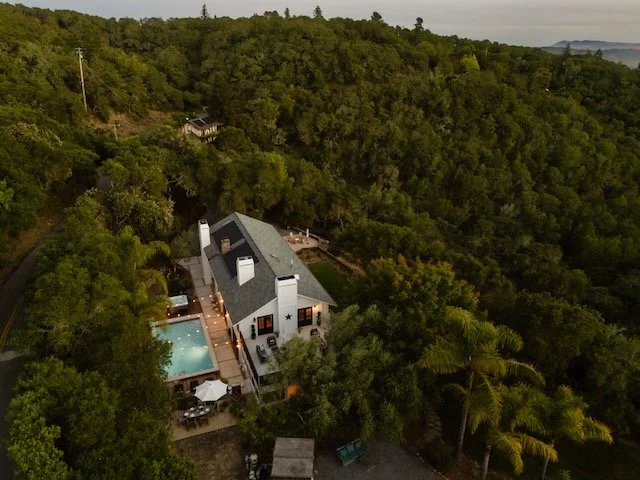
This property sits on a ridgeline above the Sonoma Valley, embedded in a dense canopy of California oak and bay laurel. From the air, the house is nearly invisible — a white structure with a pool deck glimpsed through the tree cover, with open valley views stretching toward the bay. The existing photography had never shown any of that. It had documented rooms.

During the planning conversation, the first decision was not about which images to make. It was about what job each image needed to do before we asked what story it needed to tell. Those are different questions, and the planning session made clear that most of the existing gallery had been built without asking either one.

The cover image is not the best image in the set. It is the image with the hardest job. Its task is not to continue a narrative — it is to earn the right to begin one. Everything else in the gallery gets to work at the emotional and experiential register. The cover has five seconds to answer a single question: is this worth my attention? Only after it passes that test does the sequence begin.

The first image doesn't get to tell the story. It earns the right to tell it. Those are different jobs and they require different images.
Planning session — Sonoma Hills
Stop the Scroll
Aerial view of Bella Villa Clementina surrounded by oak canopy, Sonoma
Aerial drone at dusk — one white structure, a lit pool deck, a sea of oak canopy, open valley beyond. Negative space does what a busy image cannot: it stops the scroll.
Build Trust
Fire pit at sunset with valley views, Bella Villa Clementina, Sonoma
Fire pit at sunset, wine glasses already poured, valley rolling out behind the stone wall. The guest clicked. Now they need to know they were right to.
Complete the Story
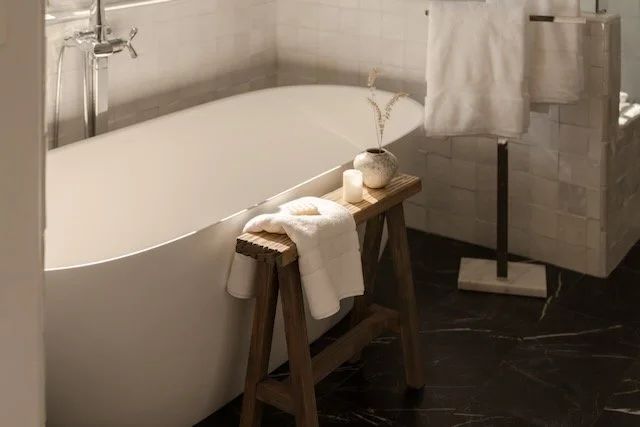
Freestanding soaker tub, Bella Villa Clementina, Sonoma
Freestanding soaker tub, marble floor, warm morning light. By image three, the guest has self-qualified. This image doesn't need to earn anything — it delivers.
01
Guest Psychology
The aerial works as a cover image because of what it does not contain. One dominant subject — a white house — surrounded by a forest canopy that communicates privacy before the guest has processed anything else. No neighboring structures. No road. No evidence that the outside world is nearby. At thumbnail scale, where most listing decisions actually begin, a busy image collapses into noise. This image has enough negative space to hold its legibility at any size. The guest's subconscious resolves the privacy question before they have consciously asked it.
02
Market Alignment
The fire pit image could not have worked as the cover. At thumbnail scale it becomes chairs around a fire — an image that requires a second look to appreciate the valley, the wine, the light softening across the hills. But after the aerial has earned the click, the fire pit lands exactly as intended: emotionally rich, specific to this place, impossible to mistake for anywhere else. The sequencing is the strategy. Neither image is wrong. Each is right only when it appears in the correct position.
03
Visual Hierarchy
The bathtub closes the sequence because by image three, the guest's job is finished. They clicked. They confirmed the location. They imagined the evening. Now they are looking for evidence that the interior matches what the exterior promised. A freestanding soaker tub in warm morning light, on marble that cost real money, in a bathroom that was designed rather than furnished — that image does not need to earn attention. It receives it. The hierarchy is: stop the scroll → validate the click → deepen the commitment.
04
Trust Signal
The aerial is a trust signal for the guest whose primary fear is false privacy claims. In this market, "private setting" appears in hundreds of listings. Most of those listings cannot show you what private actually looks like from above. This one can. A drone image that reveals no neighboring structures, no road visible from the outdoor spaces, and a canopy dense enough to create genuine visual isolation makes the same claim as the listing copy — but makes it visually and irrefutably. The guest who has been burned by a privacy claim before will read this image before they read a word.
05
Strategic Lesson
Most listing galleries are built by asking: which images are strongest? The more productive question is: what job does each image need to do, and in what order? The cover image has a fundamentally different job than every image that follows it. Its job is not to be the best photograph in the set. Its job is to earn the next five seconds. Only after it passes that test does the narrative begin. Building a gallery around that logic — hook, validate, deepen — produces a different sequence than building it around photographic merit alone. The fire pit is the richer photograph. The aerial is the better cover.
$1,388
Nightly rate — Bella Villa Clementina, Sonoma
Luxe
Airbnb Luxe designation earned following visual repositioning
VPR
Full Visual Performance Review — strategy-first, directed capture
06 — Universal Principles

What Sonoma Teaches Every Premium Market

Every market refines the Visual Performance Framework with observations that travel beyond their geography. These are the principles Sonoma reinforced — applicable across any mature, identity-driven, or culinary-primary market where authenticity is the premium signal.

Principle 01
Authenticity Cannot Be Implied — It Must Be Shown

In any market where the premium is built on authenticity rather than amenity — wine country, agricultural landscapes, heritage properties — the visual strategy must foreground the thing that makes the property belong to its place. An image that could have been taken anywhere in the country is not just missed opportunity; it actively undermines the positioning claim. The vineyard behind the dining table, the valley oak canopy framing the pool, the fog rolling over the ridge at morning: these are not stylistic choices. They are the argument.

Applicable to
Sonoma
Hudson Valley
Hill Country, TX
All agricultural markets
Principle 02
Culinary Infrastructure Is a Primary Conversion Asset, Not a Secondary Detail

In markets where cooking and dining are part of the core guest experience — wine country, coastal fishing communities, farm-stand regions — the kitchen and outdoor dining images are not supplementary. They are conversion assets that carry as much weight as the hero exterior shot. A professional range photographed badly, or not photographed at all, loses the guest who planned their entire stay around what they intended to cook. That guest is worth converting. The image that converts them is not difficult to make. It just requires treating the kitchen as primary rather than incidental.

Applicable to
Sonoma
Lake Tahoe
Malibu
All culinary-primary markets
Principle 03
Sub-Market Precision Outperforms Regional Branding

Sonoma is four distinct markets sharing a county boundary. A property positioned as "Sonoma wine country" competes against everything. A property positioned as "Healdsburg — eight minutes to the Plaza, direct views of Dry Creek Valley vineyards" competes against a much shorter list and attracts guests who already know they want exactly that. Specificity is not limiting. It is qualifying. The right guest self-selects in. The wrong guest — the one who would leave a disappointed review about the drive time — self-selects out before they book.

Applicable to
Sonoma
Lake Tahoe
Joshua Tree
All multi-zone markets
07 — Evaluate Your Own Listing

If Your Sonoma Listing Isn’t Converting, Start Here

The most common report from Sonoma owners: “We’re getting views but people aren’t booking.” In almost every case, the answer is in one of five places — and most owners have not checked all five. Work through these against your current gallery before investing in new photography or optimization.

01

Does your hero image communicate that this property belongs to Sonoma specifically — or does it show a beautiful house that could be anywhere? If the vineyard, the valley oaks, the ridge, or the agricultural landscape around the property does not appear in your first image, you are leading with the house rather than the place. At this price point, the place is the reason for booking.

02

Does your outdoor dining image show the table set, or empty? An empty outdoor table is furniture. A table set for a dinner that hasn't happened yet is a promise. The guest who plans to host a long harvest-season dinner on your terrace needs to see that image before they commit to the rate. If your gallery does not have it, someone else's does.

03

Does your listing explicitly address the noise ordinance and pool heating policy — before guests ask? These are the two most common sources of negative reviews in the Sonoma premium tier. A listing that states both clearly converts guests who would otherwise send a pre-booking message or, more expensively, book and leave a surprised review.

04

Is the kitchen appliance quality visible in your gallery? If your property has a Wolf range or Sub-Zero refrigeration and that equipment does not appear in the listing images, you are paying the purchase premium without receiving the conversion benefit. Name the brands in copy. Show the range from an angle that communicates scale and caliber. The epicurean guest who plans their meals in advance will make a booking decision based on that image.

05

Which of the three guest profiles is your listing actually built for? If the answer is all three, review whether your first six images address the distinct needs of any one of them in sequence. The epicurean purist, the multigenerational gatherer, and the tech decompressor are all willing to pay the same rate. They are not willing to book a listing that was designed for someone else.

Next Step

Curious How Your Listing Compares?

A Visual Performance Review applies this market intelligence directly to your property — identifying where your listing is losing trust — and exactly how to fix it.

Continue Reading

Other Visual Performance Field Guides

Each market has its own guest psychology, visual language, and conversion logic. The framework travels; the application is always specific.